Trump's Tariffs After IEEPA
The Supreme Court struck down IEEPA but the trade war is far from over.
Jaron Lewis
2/23/20262 min read
The ruling provided by Chief Justice Roberts, who spoke for the majority, outlined that IEEPA does not constitute clear congressional authorization to impose tariffs of unlimited scope and duration.
Questions that remain unanswered are:
Reciprocal tariffs
Refunds (currently $175 Billion in potential reimbursements)
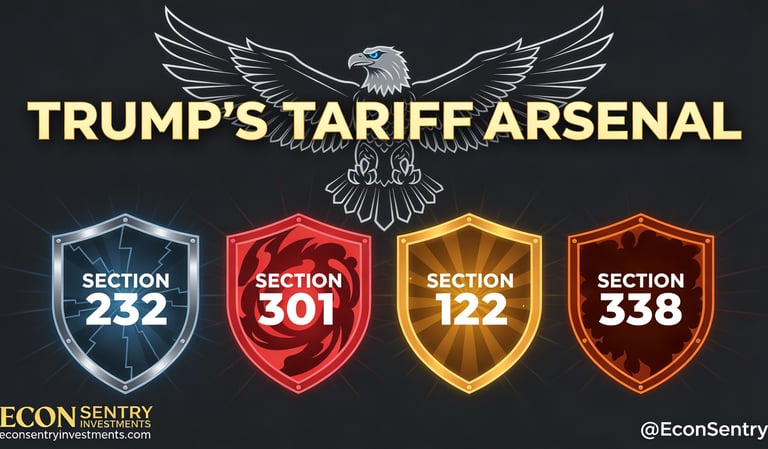
Here are the remaining Tariff actions President Trump can take along with their individual power and comparison to IEEPA:
Section 122: The immediate "Plan B" of President Trump, the Trade Act of 1974. This allows the President to impose up to 15 percent tariffs to address large balance of payments deficits.
Powerful components of this section:
No formal investigation required
Short-term negotiation leverage in ongoing trade talks
Limitations of Authority:
Capped at 150 days
Must be applied uniformly across all countries
Section 232: The Trade Expansion Act of 1962 allows tariffs on imports threatening national security. This imposed act follows a Commerce Department investigation and has already been used for tariffs on steel, aluminum, copper, and semiconductors, automobiles, lumber, and heavy trucks. These tariffs will remain in full effect and there is no cap on the rate in addition to coverage expanding to derivative products.
Powerful components of this section:
No rate ceiling (unlimited tariff levels)
Already legally tested and upheld by courts
Can be expanded to additional sectors
Permanent if not overturned by Congress
Limitations of Authority:
Months-long investigation
Can be overturned by Congress
Section 301: Another Trade Act of 1974 authorizes the U.S. Trade Representative to respond to unreasonable or discriminatory foreign trade practices. This is the current backbone of China tariffs.
Powerful components of this section:
Broad toolkit with no tariff rate cap
Extensive pressure on China
Difficult to unwind once imposed
Country-specific targeting
Limitations of Authority:
Formal investigation required
Section 338: The Tariff Act of 1930 allows tariffs up to 50 percent on imports from countries that discriminate against U.S. commerce. This section remains a nuclear option and has not been invoked by the administration.
Powerful components of this section:
Highest authorized rate of any remaining authority
President can act on a "self-initiation" finding of fact, without investigation
Could be applied to countries who refuse to negotiate
Limitations of Authority:
Untested
50% tariff rate cap
High litigation risk
The power of IEEPA tariffs lay in the speed, implementation, and impact across various countries. The Supreme Court decision curtails these presidential powers.
The remaining authorities under President Trump are limited overall by their speed, time of imposition, and don't immediately replicate the shock of IEEPA tariffs, limiting negotiating power in the near term.
The tariff decision also cut the effective rate on Chinese imports by nearly two-thirds and reduced rates on Canada and Mexico marginally. This underscores the geopolitical pressure that persists and remains a concern through other mechanisms in use by the administration.
Although firepower remains available to the administration through "Section 232" as investigations are well underway, investigations could continue to take months as new tariffs are imposed on additional sectors.
Section 232 remains largely unaffected by the decision and this maintains a definitive amount of pressure on China.
© 2026 ECON Sentry Investments LLC. All rights reserved


ECON Sentry
Your strategic partner for navigating global markets with precision intelligence and tactical expertise.
cONTACT US
jjaron.lewis@econsentryinvestments.com
📱 410-803-5051
Copyright © 2026 - ECON Sentry